
Socrait for MTSS and PBIS
Behavior Data Starts in the Moment, Not at the End of the Day
Did you warn a student in third period about being out of their seat or was that in the homeroom? What was the specific praise a student got last Friday at the end of the day? Who has been quiet this week and needs engaging? Holding all the details of the behavior, redirections, and classroom behavior observations from each day adds up quickly. It can become unsustainable quickly and details evaporate (especially with praise), timeliness gets lost, and partial recollections start becoming the norm (if things get documented at all).
It is what happens when you are managing 30 students in a room for six hours a day, and every system you have asks you to stop teaching in order to document what just happened.
Socrait closes the gap between the moment and the record. Teachers speak naturally while they teach and Socrait collects the praise, warnings, observations, and classroom events by voice, in real time, so nothing has to be carried in the teacher’s head until the end of the day. The result is behavior data that is more complete, more timely, and structurally less skewed toward the negative. Teachers can stay in the flow of teaching, focusing more on students, and less on the disruptions or necessity to document.
For MTSS coordinators, administrators, and support teams: the data your Tier 1 process depends on is only as good as what gets collected at the classroom level. Socrait is the collection layer between the teacher and the equitable support your students deserve.
WHAT THE RESEARCH SHOWS
The Praise Gap Is Real, Measured, and Costly
Decades of classroom observation research point to the same finding: most teachers reprimand far more than they praise, and most teachers don’t realize it.
Teachers reprimand more than they praise without knowing it
In a three-year study across 151 elementary classrooms and 2,536 students in Missouri, Tennessee, and Utah, researchers observed roughly 6.5 reprimands for every 1 instance of praise at baseline. At that ratio, on-task student behavior hovered around 40 percent 1.
Separately, researchers found that teachers consistently estimate they praise more often than observers actually record. The gap between what teachers think they are doing and what they are actually doing is one of the most persistent findings in the classroom management literature 2.
When the ratio shifts, behavior shifts
Across those 151 classrooms, as the praise-to-reprimand ratio increased, on-task behavior increased in a positive linear relationship. Students in classrooms with the highest ratios spent 20–30 percent more time focused on the teacher or the task. No magic threshold was found — the relationship was linear with no ceiling. Even reaching a 1:1 ratio pushed on-task behavior to about 60 percent 1.
The pattern holds beyond elementary school. In a study of 28 middle school classrooms, higher praise-to-reprimand ratios predicted improved on-task behavior, higher grades for students at risk for emotional and behavioral disorders, and decreased disruptive behavior 3.
Do reprimands actually work?
A short-term longitudinal study tracked 149 teachers and 311 at-risk students across 19 elementary schools in three states. Cross-lag analysis showed that teacher reprimands did not reduce students’ future disruptive behavior and did not increase future engagement 4. Reprimands may suppress misbehavior in the moment, but over time the misbehavior returns. Meanwhile, teachers who deliver high rates of reprimands report higher levels of emotional exhaustion 5. And that exhaustion may not stay with the teacher: the first systematic review of teacher burnout and student outcomes (14 studies, more than 5,000 teachers and 50,000 students) found preliminary evidence that teacher burnout is associated with worse student academic achievement and lower-quality student motivation 6. The reprimand-heavy cycle is costly on both ends of the room.
PBIS and the data that feed it
Positive Behavioral Interventions and Supports is the most-studied framework for school-wide behavior management. In a randomized controlled trial across 37 elementary schools, students in PBIS schools were 33 percent less likely to receive an office discipline referral 7. A 2023 systematic review confirmed that PBIS meets evidence-based criteria for reducing exclusionary discipline. PBIS is now implemented in more than 25,000 schools globally 8.
But every PBIS framework depends on Tier 1 classroom data as its foundation. If praise is not getting collected at the classroom level, the data flowing into MTSS decision-making is structurally incomplete. Authentic behavior-specific praise, the kind the research shows actually changes behavior, is the first thing lost when teachers are too busy to document in real time 9.
The real obstacle: teachers can’t see their own patterns
Research consistently shows that self-monitoring alone — without any external coaching — increases teacher praise rates. The act of counting changes behavior 10. But counting while teaching is one more demand on a teacher who is already managing instruction, behavior, timing, and 25 individual students. The feedback loop that drives improvement has historically required a coach with a clipboard or a video camera, both of which are expensive in time and impossible to sustain daily 11.
Newer tools are beginning to close that loop without a coach in the room. A 2024 systematic review of classroom-behavior-management apps found preliminary evidence that app-based self-monitoring can support positive behavior change, with moderate-to-strong effects in the strongest studies, even as the broader evidence base is still young 12.
This is the gap Socrait was built to close. Not the gap in the research; that’s settled. The gap between the moment a teacher praises a student and the moment that praise shows up as usable data.
This matters in your state
MTSS and PBIS implementation requirements vary by state, but the underlying need is the same everywhere: accurate, timely Tier 1 behavior data collected at the classroom level. Socrait supports teachers and schools operating under the behavioral frameworks required in states across the country.
Learn more about how Socrait supports compliance and best practices in your state:
HOW SOCRAIT WORKS
The Collection Layer Between You and Your Data
Socrait is not a behavior management system. It is not replacing your PBIS framework, your MTSS platform, or your school’s system of record. Socrait is the collection layer, the piece that makes the data going into those systems accurate, timely, and complete.
Teachers teach. They make observations about students, praise students, warn students, take attendance, and teach lessons. Socrait listens to the teacher’s voice and documents what happened so they don’t have to carry it all in their head until the planning period.
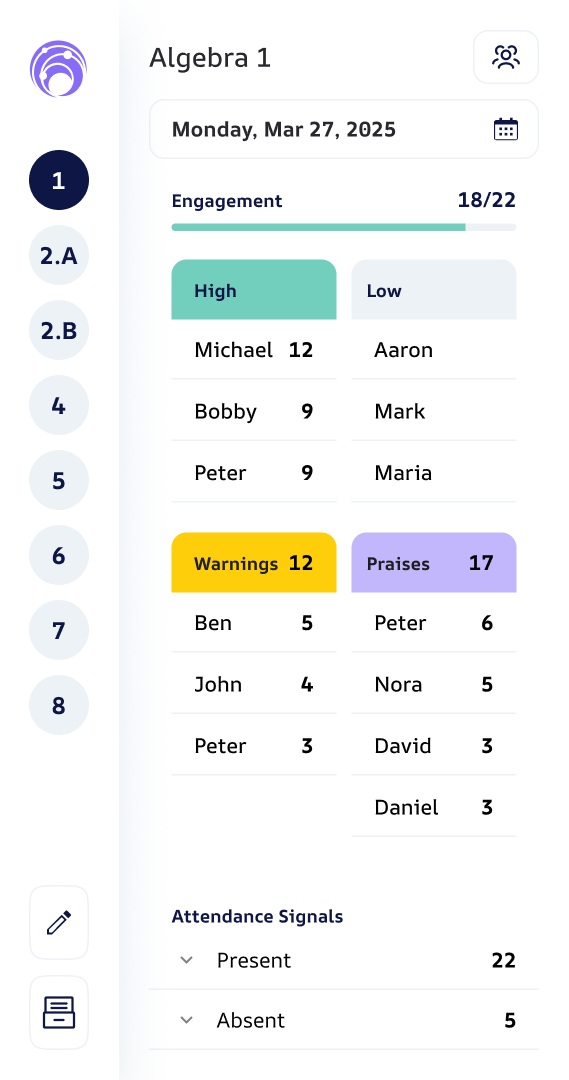
Praise and Warning Tallies
Every time a teacher praises or warns a student by name, Socrait collects it. At the end of class, when a teacher logs into their dashboard, they can see the count of who was praised, who was warned, and how many times. For most teachers, this is the first time they’ve ever seen their own praise-to-reprimand ratio. The research says seeing it is the first step to changing it.
This is also the data that makes the positive visible. When a student is discussed at a Tier 2 or Tier 3 meeting, the praise tally ensures that the conversation starts with what that student has done well, not just the referrals that brought them to the table.
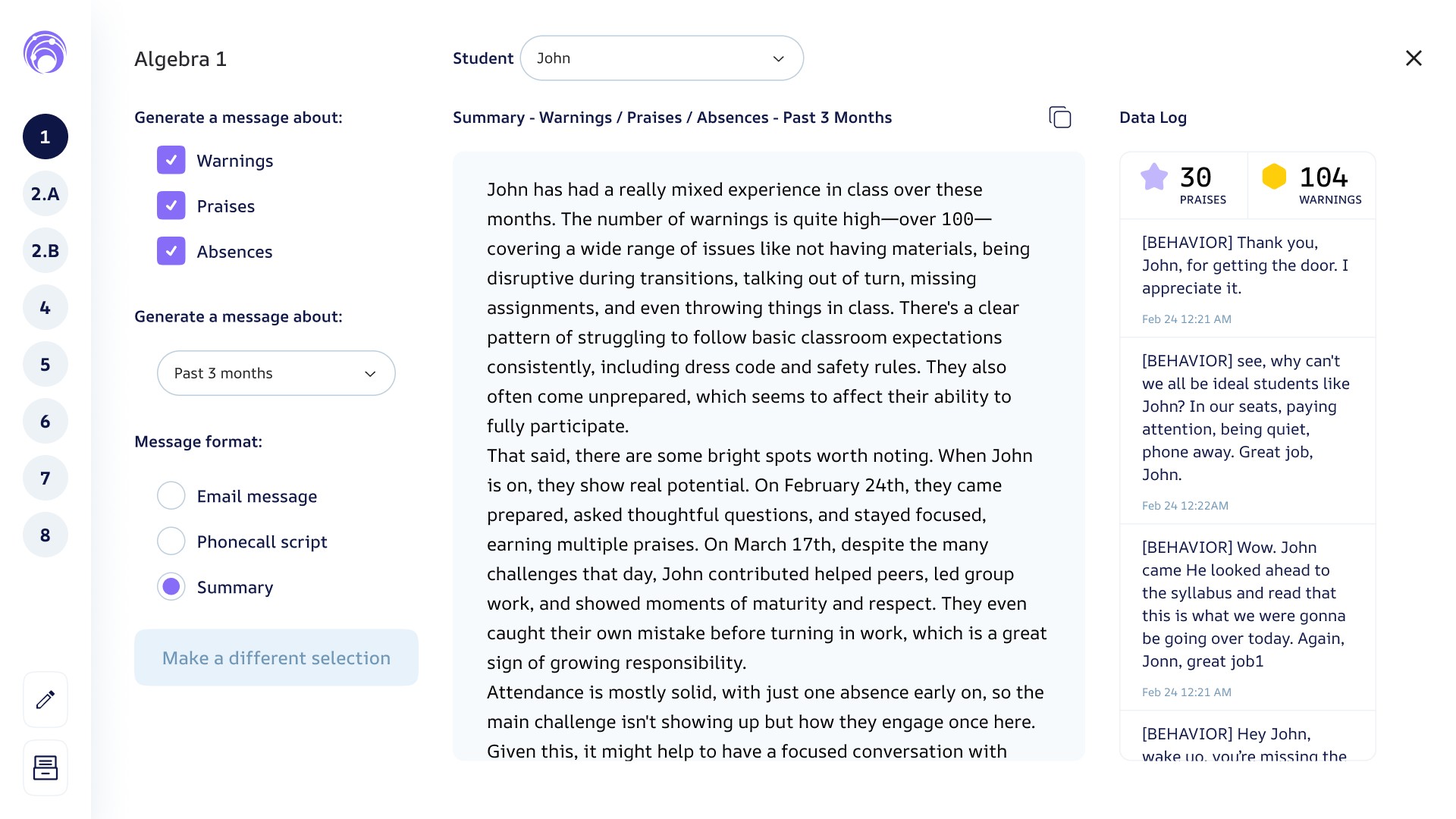
Student Profile Data
Socrait builds a running profile for each student based on what happens in class, day over day. Praise patterns, warning patterns, engagement trends, and participation moments accumulate into a portrait that is structurally fuller than what any teacher could reconstruct from memory. Because Socrait collects both the good and the hard in real time, the student’s record is not skewed toward the moments that forced a referral. It reflects what actually happened.
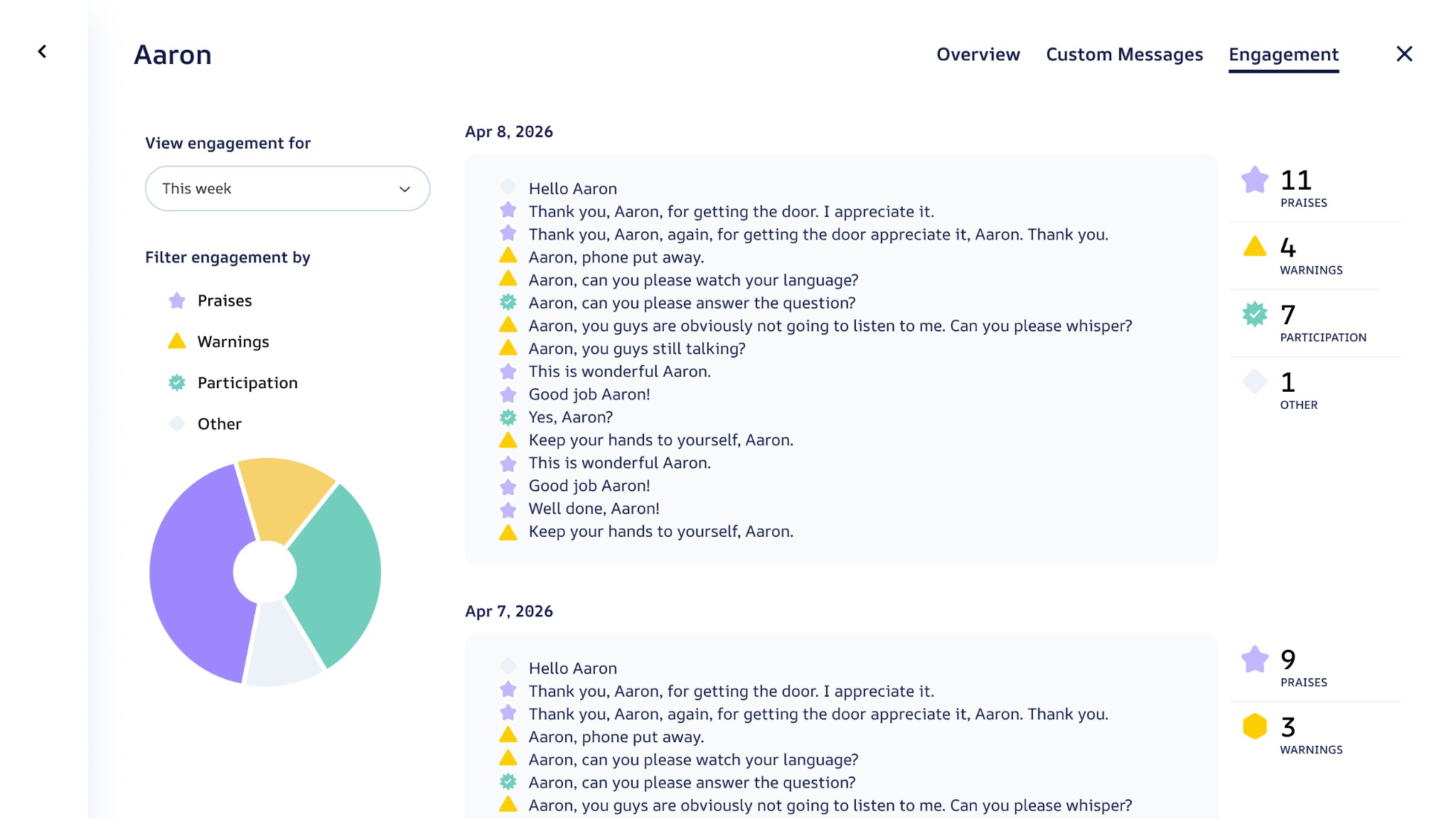
Engagement and Participation
Socrait tracks which students are called on, who participates in discussion, and how engagement patterns shift across the class period. For teachers working within a PBIS or MTSS framework, this is daily classroom experience data for Tier 1 rarely never gets collected at all or only exists in the teacher’s head, if it exists anywhere.
Attendance Signals
Socrait collects attendance context mentioned during class, who was absent, who arrived late, who left early, as part of the natural flow of the session. This is not a replacement for your attendance system. It is one more signal collected without interrupting instruction.
No audio is ever stored.
No student or teacher data is sold. Socrait is FERPA-compliant, and Socrait is a Public Benefit Corporation. The student profile is built from the teacher’s own spoken observations, not from stored audio, not from surveillance, not from student-facing data collection. The teacher’s voice is the only input. The student’s privacy is protected by design.
WHAT TEACHERS SAY
The Praise That Would Have Disappeared
“The warnings and the praises are huge, especially praises, for me. Keeping track of the good things can be hard sometimes in life in general.”
Duncan Larsen,
CTE Teacher,
Freedom Prep Academy
“The praises and the warnings were very enlightening for me as a teacher to be like, whose names am I saying over and over again? Sometimes it’s the same kids and it’s warranted. It’s for me to look at at the end of the day, and ask myself, who am I not praising when I should be praising?”
Michelle Spencer,
Elementary Teacher,
Detroit, Michigan
“Socrait would remind me of things that happened during class that I didn’t remember. I was able to review praises, warnings and follow-up to share with students and parents.”
Megan Theorine,
Middle School Teacher
The Weight It Takes Off
“Now I have a fallback, so now I can concentrate more on what I’m trying to do in class instead of remembering everything.”
Kelli Chaves,
Teacher
“I think it has helped with my stress levels, absolutely, knowing that I don’t have to track it now — like, that actually takes a load off your mental, cognitive engine, like, you’re like, okay, I don’t need to actually remember all this.”
Kayden McInnis,
High School Teacher
“It was eye-opening, because after a day when they were absolute wild demons — maybe it was a full moon — I read the data and thought, That didn’t happen today. Then I realized: Oh wow. That was today. The behaviors were so off the wall that I had forgotten by the end what I dealt with at the beginning.”
Jessie Rezba,
Middle School Teacher and Union Leader
The Data That Stands on Its Own
“The praises and the warnings were very enlightening for me as a teacher to be like, whose names am I saying over and over again? Sometimes it’s the same kids and it’s warranted. It’s for me to look at at the end of the day, and ask myself, who am I not praising when I should be praising?”
Michelle Spencer,
Elementary Teacher,
Detroit, Michigan
“The warnings and the praises are huge, especially praises, for me. Keeping track of the good things can be hard sometimes in life in general.”
Duncan Larsen,
CTE Teacher,
Freedom Prep Academy
Close the Gap Between the Moment and the Data
See how Socrait collects Tier 1 behavior data by voice without adding a single task to the teacher’s day.
CITATIONS
1.
Caldarella, P., Larsen, R. A. A., Williams, L., Downs, K. R., Wills, H. P., & Wehby, J. H. (2020). Effects of teachers’ praise-to-reprimand ratios on elementary students’ on-task behaviour. Educational Psychology, 40(10), 1306–1322. https://doi.org/10.1080/01443410.2020.1711872
2.
Floress, M. T., Jenkins, L. N., Reinke, W. M., & McKown, L. (2018). General education teachers’ natural rates of praise. Behavioral Disorders, 43, 411–422.
3.
Caldarella, P., Larsen, R. A. A., Williams, L., & Wills, H. P. (2023). Effects of middle school teachers’ praise-to-reprimand ratios on students’ classroom behavior. Journal of Positive Behavior Interventions, 25(1), 28–40. https://doi.org/10.1177/10983007211035185
4.
Caldarella, P., Larsen, R. A. A., Williams, L., Wills, H. P., & Wehby, J. H. (2021). “Stop Doing That!”: Effects of teacher reprimands on student disruptive behavior and engagement. Journal of Positive Behavior Interventions. https://doi.org/10.1177/1098300720935101
5.
Reinke, W. M., Herman, K. C., & Stormont, M. (2013). Classroom-level positive behavior supports in schools implementing SW-PBIS. Journal of Positive Behavior Interventions, https://doi.org/10.1177/1098300712459079
6.
Madigan, D. J., & Kim, L. E. (2021). Does teacher burnout affect students? A systematic review of its association with academic achievement and student-reported outcomes. International Journal of Educational Research, 105, 101714. https://doi.org/10.1016/j.ijer.2020.101714
7.
Bradshaw, C. P., Waasdorp, T. E., & Leaf, P. J. (2012). Effects of School-Wide Positive Behavioral Interventions and Supports on child behavior problems. Pediatrics, 130(5), e1136–e1145. https://publications.aap.org/pediatrics/article/130/5/e1136
8.
Santiago-Rosario, M. R., McIntosh, K., Izzard, S., Cohen-Lissman, D., & Calhoun, T. E. (2023). Is Positive Behavioral Interventions and Supports (PBIS) an Evidence-Based Practice? Center on PBIS, University of Oregon. pbis.org
9.
IRIS Center, Vanderbilt University. Behavior-Specific Praise module. https://iris.peabody.vanderbilt.edu/module/bi2-elem/cresource/q1/p02/
10.
Reinke, W. M., Lewis-Palmer, T., & Merrell, K. (2008). The Classroom Check-up. School Psychology Review, https://doi.org/10.1080/02796015.2008.12087879
11.
Wilkinson, S., Freeman, J., Simonsen, B., Sears, S., Byun, S. G., Xu, X., & Luh, H.-J. (2020). Professional development for classroom management: a review of the literature. Educational Research and Evaluation, 26(3–4), 182–212. https://doi.org/10.1080/13803611.2021.1934034
12.
Mittiga, S. R., Freeman, N. C., Leif, E. S., Furlonger, B. E., & Pattison, E. (2024). Behavior change potential of classroom behavior management mobile applications: A systematic review. Education and Treatment of Children, 47, 83–104. https://doi.org/10.1007/s43494-024-00122-3