
Socrait for Parent Engagement
Family Engagement, Memory, and Teachers’ Capacity
Socrait is a voice-powered class companion, built by teachers, for teachers. It collects classroom moments as they happen, so the parent-teacher conference, the email, the phone call, and the IEP meeting all start from the same place: what actually happened, by name, by date, in a teacher’s own words.
Family communication requires multiple inputs and outputs:
- The parent-teacher conference where a teacher has twelve minutes and a gradebook.
- The email about positive growth that never got sent.
- The phone call that needs details and a professional tone.
They all fail for the same reason: memory.
In every one of them, the limiting factor is the same: what a human being can hold in their head after teaching all day, for months, for a hundred and forty kids.
For principals and family-engagement leads:
The communication you most want from teachers is frequent, specific, and not only about problems. That is also the communication teachers have the least capacity to produce. Socrait creates drafts based on both positive and negative interactions, so it’s easier to spread good news home.
“Socrait is helping our teachers provide more accurate information about what’s happening in class. They finally have productive conversations with students and families.”
Kim Hamilton,
Vice Principal
PARENT-TEACHER CONFERENCES
Preparing For Parent-Teacher Conferences
The parent sits down, and, before teachers get to the grades, they ask a question the gradebook cannot answer: Is he participating? Does she have friends in class? Is he actually trying, or is he checked out?
Teachers know the answer. Teachers just can’t produce the evidence. What exists is an average and an impression, and impressions are exactly what a skeptical parent pushes back on. “That doesn’t sound like my kid at home.” And no teacher wants to defend feelings.
The teacher who can say “the third week of September was when he started raising his hand, here are the four days I noted it, and it stopped the week of October 14th” is not having the same meeting. That teacher is having a conversation about a real kid, on a real timeline, with a parent who now believes their child is being watched by someone who noticed.
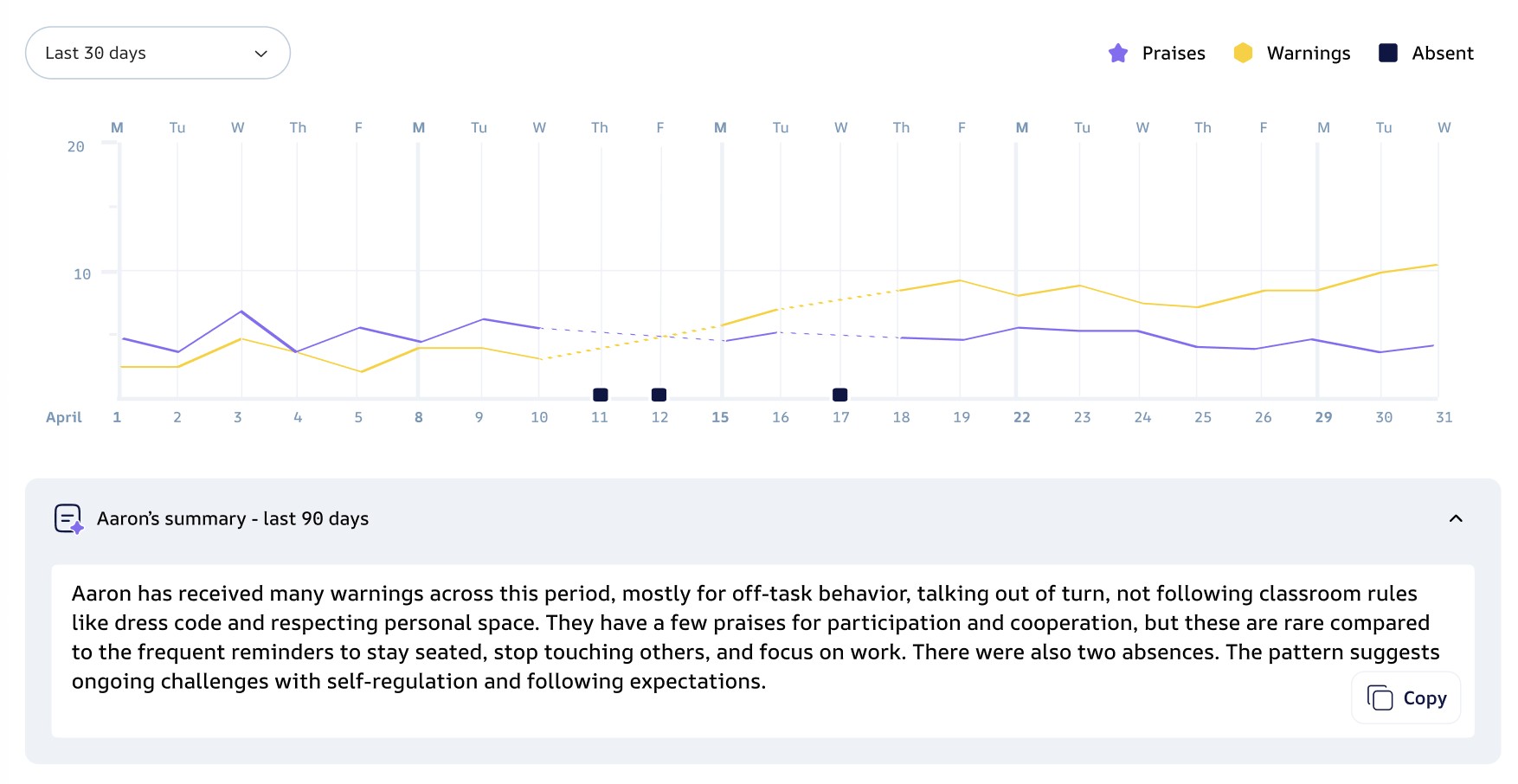
That record accumulates from the first week of school, in the ordinary course of teaching. Socrait collects the praise, the redirections, the moments teachers notice, with names, dates, and details. By the time conferences arrive, teachers are not reconstructing a semester. They are reading it.
“I loved the end-of-day email summary. It was a perfect sandwich of good, bad, good, framed in a bias-neutral way, but in a way that supported partnership and growth. It gave me a framework to start writing, and that helped so much in building the relationships I needed.”
Jessie Rezba,
Middle School Teacher and Union Leader
PARENT EMAILS
Socrait Jump-Starts the Process
The teacher notices, and Socrait remembers
The math of a teaching job: a hundred small things teachers noticed, a blank message box for each student, and minutes spent crafting an email specific enough to matter, professional enough to forward. After teaching all day, the energy to start writing that email, especially a hard one, is more than most people have left.
At the end of class, Socrait turns what happened into a draft message ready to copy,paste, edit and send: what was praised, what was flagged, what to follow up on, written in clear, professional language. Teachers adjust it until it sounds like them, and send it.
Because it collects praise alongside redirections, the easiest message to send becomes a positive one. The “I wanted you to know what your kid did well today” email (the kind of message research says matters most and teachers rarely find time for) is right there and already specific. Families who hear good news first, answer the phone differently when the news is hard.
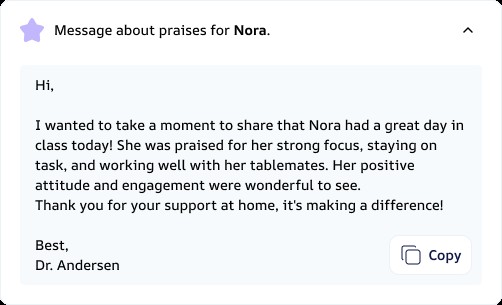
“I love the email feature, because I don’t have to worry about it sounding professional. In Socrait, it’s already typed up for me, and I literally just copy and paste. That’s been really helpful, and it’s made my parent communication daily better.”
Aleena Stephens,
Math Teacher,
Claggett Creek Middle School
WHAT THE RESEARCH SHOWS
The Power of the Message Home
When teachers reach families, students change
In a randomized field experiment, frequent teacher-family communication, a regular call plus a short written message, increased the odds a student completed their homework by roughly 40 percent. It also cut the number of times teachers had to redirect a student’s attention by 25 percent, and raised class participation by about 15 percent. The researchers traced the effect to three things: stronger teacher-student relationships, more parental involvement, and higher student motivation.[1]
Small, specific messages move real outcomes
In another field experiment, sending parents a brief, individualized one-sentence message each week reduced the share of students failing to earn course credit from about 16 percent to 9 percent, a 41 percent drop, mostly by keeping students from dropping out. The messages that named something specific a student could work on, or something they were doing well, had the largest effects.[2]
The operative word is specific. A generic message home does not do this. The reason teachers don’t send specific messages is not that they don’t know specificity works. It’s that specificity requires remembering interactions in detail.
Most families barely hear from school, except when something's wrong
The same research notes what every teacher already knows: families receive remarkably little communication from school, and what they do get skews negative. For many parents, a message from a teacher means trouble, which is exactly why the positive note carries so much weight and the behavior conversation is so fraught, especially with families whose own experiences with school weren’t good. Decades of family-engagement research connect stronger school-family relationships to better attendance, behavior, and achievement, even where that evidence is correlational.[3]
The bottleneck is not whether communication helps. It’s whether an exhausted teacher can produce it, consistently, in a tone that builds trust.
Early signal: what teachers in our pilots report
Socrait is a newer product, so we report usage and teacher-reported experience before we make broad outcome claims. In post-pilot surveys, teachers rated their agreement on a five-point scale. These are self-reported averages from teachers using Socrait, an early signal and not independent research, and we share them as such:
4.5 / 5 “Assisted by Socrait, I feel comfortable producing emails to parents about a student’s behavior.”
4.2 / 5 “Assisted by Socrait, I have the objective facts when a parent or admin challenges a behavior report.”
4.0 / 5 “Assisted by Socrait, I feel like I can do all the follow-up that is needed.”
4.0 / 5 “Teaching feels more manageable with Socrait.”
The pattern is consistent across pilots. The parts teachers feel most supported on are exactly the parts of family communication that are usually hardest: starting the behavior email, and having the facts ready when a conversation gets challenged.[4]
Parent engagement in your state
Many states and districts set their own expectations for how and how often schools communicate with families, including progress reporting, behavior notification, and home-language access. Socrait supports teachers communicating under those requirements, in plain language families can actually use.
See how Socrait supports family communication in your state:
THE PHONE CALL
Preparing for a Parent Call
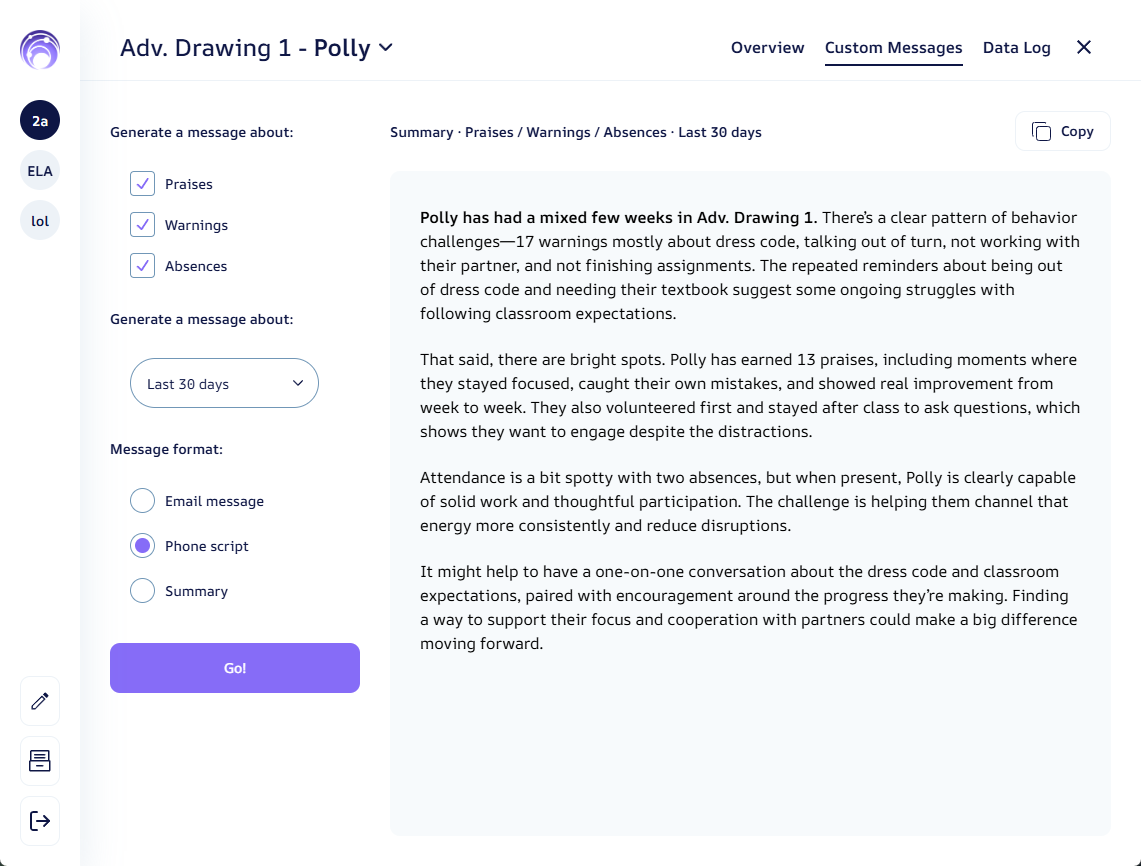
Email is not always the right channel to reach families. Some conversations have to be a phone call, and the phone call is harder. There’s no draft to edit, no chance to reread it before it goes. Teachers get one take, live, with a parent whose reaction can’t be predicted.
With custom messages, Socrait can turn what it collected into a call script: the specific examples teachers want to lead with, the redirection needing focus, the ask for collaboration, in the order that keeps the conversation a partnership. Teachers use the script to prepare and demonstrate their attention to the student, leading to better relationships.
Socrait for Parent Engagement
Bring Socrait to your school. Schedule a demo today to learn how we can help you meet your school goals.
CITATIONS
1.
Kraft, M. A., & Dougherty, S. M. (2013). The effect of teacher–family communication on student engagement: Evidence from a randomized field experiment. Journal of Research on Educational Effectiveness, 6(3), 199–222. https://doi.org/10.1080/19345747.2012.743636
2.
Kraft, M. A., & Rogers, T. (2015). The underutilized potential of teacher-to-parent communication: Evidence from a field experiment. Economics of Education Review, 47, 49–63. https://doi.org/10.1016/j.econedurev.2015.04.001
3.
Henderson, A. T., & Mapp, K. L. (2002). A New Wave of Evidence: The Impact of School, Family, and Community Connections on Student Achievement. Southwest Educational Development Laboratory (SEDL). https://sedl.org/connections/resources/evidence.pdf
4.
Socrait post-pilot teacher surveys (internal, self-reported, 5-point agreement scale). Sample size and methodology available on request.