
How Socrait impacts student outcomes
Student progress, evaluation, and support all start with classroom experiences, observed and documented by a teacher. When a tired teacher runs out of mental space, the first thing that disappears is the observation made in the moment about a specific student.
With Socrait, each behavior comment, each noticing about lesson progress, and every observation about a student’s engagement, said out loud by a teacher during class, is preserved. Those words become the behavior record, the MTSS note, the IEP progress data, instantly ready for the next meeting, with no extra work.
No audio stored. Student data never sold. FERPA compliant. iKeepSafe FERPA certified. ISO 27001 certified. EdSafe Alliance member. Public Benefit Corporation.
Socrait reinforces a positive environment for learning
Student outcomes are shaped by more than a student’s proficiency at answering questions. Learning happens when students feel safe and feel like they belong. That feeling is built out of small, specific, repeated acts of being noticed by an adult.
A student's name is the smallest unit of belonging
A teacher who never calls on a student, never uses their name, or says it wrong every day for a year is teaching that student something. Interviews with 41 students of color across K-12 schools found that having a name mispronounced, disregarded, or changed carried lasting effects on students’ sense of self and their view of their own culture, with participants describing anxiety, othering, and dread of roll call that persisted for years.[^1]
Socrait works by name. Teachers need to say a student’s name out loud as part of the observation, because that is how the data gets attached to the right child. Research shows this practice (saying the names out loud) is highly beneficial.
Teacher support is the single strongest predictor of whether a student feels they belong at school. Across 51 studies covering 67,378 students, teacher support and teachers’ positive personal characteristics outranked peer support, parent support, extracurricular activities, and school safety. Students who believe their teachers are caring, empathic, and fair report a stronger sense of belonging.[^2]
“I love your product and I think it makes me a better teacher. I find myself saying their names intentionally so that I can capture data and repeating myself more often, which is never a bad thing when it comes to teenagers.”
Staci Weeks,
High School Math Teacher,
South Aiken High School
The relationship is the thing that works
Teacher-student relationships matter enormously for students. The most comprehensive synthesis available, covering roughly 70 years of research and more than 2.6 million students, found similar large and significant relations between teacher-student relationships and eight clusters of student outcomes, including academic achievement, motivation, behavior, and wellbeing. Relationships mattered more in middle and high school than for younger children, and mattered equally for boys and girls.[^3] An earlier meta-analysis of 99 studies found associations with student engagement that were medium to large.[^4]
This is the mechanism behind most tiered behavior frameworks, including PBIS. The frameworks exist to make positive adult attention systematic instead of accidental.
The parent message that actually moves the outcome
The strongest causal evidence on this page is about teacher-parent communication.
In a randomized field experiment, teachers sent parents of high school students in a credit recovery program one individualized sentence per week. The share of students who failed to earn course credit fell from 15.8% to 9.3%, a 41% reduction, driven almost entirely by preventing students from dropping out rather than by reducing failure or dismissal rates.[^5] The researchers estimated the cost per additional credit earned at less than one tenth the district’s typical cost per credit.[^5]
One sentence
Once a week
From the teacher
Messages emphasizing what a student needed to improve produced larger effects than messages emphasizing what the student was doing well.[^5]
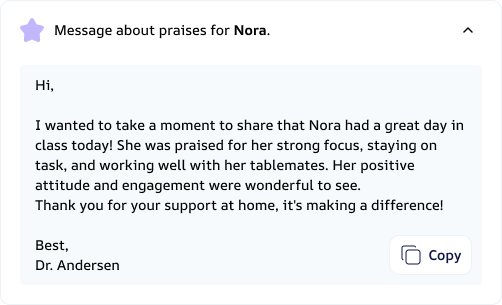
Teachers want to contact parents, but writing an individualized message about a specific child requires remembering something specific about that child, at 6pm, after hours of teaching hundreds of students. With Socrait, the specific thing is already written down, in the teacher’s own words, attached to the student’s name. The automatically drafted emails are ready to copy and paste each day after class.
“I love the email feature, because I don’t have to worry about it sounding professional. In Socrait, it’s already typed up for me, and I literally just copy and paste. That’s been really helpful as well, and it’s made my parent communication daily better.”
Aleena Stephens,
Math Teacher,
Claggett Creek Middle School, Oregon
Socrait frees teachers to focus on students and instructional time
The teacher sees it first, and the system finds out last
Early warning systems work. Following a cohort of urban middle-grade students, researchers found that indicators reflecting poor attendance, misbehavior, and course failure in sixth grade identified 60% of the students who would not go on to graduate from high school.[^6]
Those indicators are: attendance, behavior, course performance. Two of the three are things a teacher watches happen in front of her, in real time, weeks or months before they show up in a record.
The early warning signal is not a report the district runs in March, but a teacher noticing, in October, that a specific kid has stopped talking. The question is whether that noticing becomes data or evaporates. When escalating behavior or interventions are up for discussion, Socrait ensures that early warning data is present,
“It reminds me of all the behaviors that I commented on through the class period that I don’t always remember. It reminds me specifically of some of the issues that I need to contact home about and it reminds me to offer praises to students too. I love that I have reminders to focus on the positives and not just the negatives.”
Megan Theorine,
Middle School Teacher,
Beehive Science and Technology Academy
The cost of writing it down while teaching
A teacher’s attention is finite in a measurable, non-metaphorical way.
The dual-process framework cognitive scientists use to describe classroom teaching holds that a teacher’s performance is driven substantially by cognitive load, and that overload pushes practice toward whatever has become automatic.[^7] Every teacher knows: when the room is loud and the clock is against you, the deliberate noticing goes first and the routine takes over.
Philip Jackson’s classroom observations put elementary teachers at 200 to 300 interpersonal exchanges every hour, most of them unplanned.[^8]
On top of that, stopping to write is a different task; it pulls the eyes off the room, breaks the thread of the lesson, and hands the class a gap.
Administrative duties pull directly against instructional time, and there is one causal test of it. A quasi-natural experiment using random student-classroom assignment in Chinese secondary schools found that homeroom teachers’ administrative duties reduced student achievement, explained by less teaching time and reduced communication with students.[^9] That is a Chinese secondary school context, not a US elementary one, but it is the closest thing to a causal test of this question that exists anywhere.
“This is my first year ever teaching … Keeping up with student behavior, progress, and keeping absent students on track has been a major challenge for me so far. I saw your app on TikTok and I think it is absolutely genius – Especially as a first year teacher trying to keep up with all the chaos while trying to be in the moment with students!”
High School Teacher
For leaders
where the leverage actually is
Teachers are the highest-leverage in-school variable for student achievement. Analyzing matched panel data on Texas students, researchers found that schools’ effects on achievement derive most importantly from variation in teacher quality, and that moving one standard deviation up the teacher quality distribution outperforms a costly ten-student reduction in class size.[^14]
“Socrait is already helping me to do my job better because it’s helping our teachers provide more accurate information about what’s happening in class. We can more accurately pinpoint where interventions are needed and make adjustments that can save time and mental health of teachers. They finally have productive conversations with students and families.”
Kim Hamilton,
Vice Principal
Coaching works and does not scale.
Across 60 causal studies, teacher coaching produced 0.49 SD on instructional practice and 0.18 SD on student achievement.[^15] The same paper is explicit about the catch: average effects from effectiveness trials of larger programs are only a fraction of the effects found in efficacy trials of smaller programs.[^15] Coaching works because a skilled adult watches a teacher and tells them something specific about what they did. The expensive part is the skilled adult.
Curriculum scaled and did not move achievement.
Across almost 6,000 schools in six states over three school years, researchers found no difference in average fourth and fifth grade math achievement gains between schools using different elementary math curricula, concluding that at current levels of curriculum usage and professional development, textbook choice alone does not seem to improve achievement.[^16] The lead researchers were the same people who had spent years arguing curriculum was an underrated lever.
Classroom management is real and small.
g = 0.23 across 76 controlled studies.[^11]
That is the problem. The intervention with the best evidence is the one you cannot afford at scale, and the one you could afford at scale did not work.
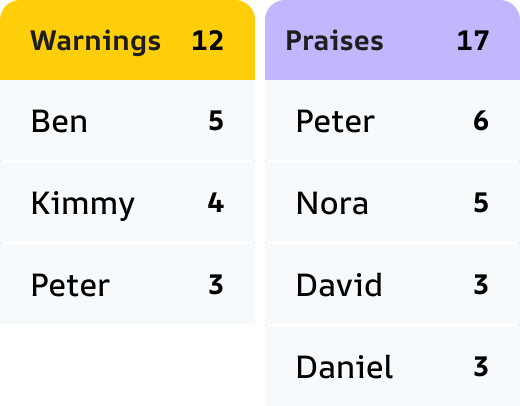
Socrait gives teachers a mirror to reflect on their teaching practices: their praise to warning ratios, their student engagement, the amount of content they covered.
What changes in the classroom
Praise is a capacity problem before it is a training problem
Higher praise-to-reprimand ratios are associated with more on-task behavior. Across three years of observation in 151 classrooms in 19 elementary schools in three states, researchers found no magic threshold at 3:1 or 4:1, but a positive linear relationship: the higher a teacher’s ratio, the higher the students’ on-task percentage.[^10] Teachers who praised most saw as much as 30% more positive behavior, and even at a 1:1 ratio students reached 60% on-task.[^10]
Noticing what a kid did right, out loud, in the second it happens, is the first thing that goes when a teacher is at the edge of her capacity.
“I’ve found Socrait to be a surprisingly effective classroom tool that supports a more positive classroom culture overall. The app collects my classroom sessions and helps track both positive and negative student behavior, which has made classroom management more balanced and reflective.”
Middle and High School Teacher
Classroom management moves student outcomes, at a knowable size
A meta-analysis of 76 controlled intervention studies published between 2003 and 2022 found that classroom management interventions produced a small but significant average effect of g = 0.23 across students’ academic, behavioral, social-emotional, and motivational outcomes.[^11] This replicates the same research team’s earlier analysis of 54 studies, which found g = 0.22.[^12]
Small and real. This meta-analysis shows that all students may benefit from classroom management interventions in primary education.[^11]
“Through a variety of changes this year, including Socrait adoption, we’ve been able to reduce our behavior issues 70% this year.”
Keith DeBono,
Secondary Vice Principal,
Beehive Science and Technology Academy
The mirror, and why the design of it matters
The largest meta-analysis of feedback interventions ever conducted, covering 607 effect sizes across 23,663 observations, found that feedback improved performance on average at d = 0.41. It also found that more than a third of feedback interventions made performance worse.[^13] The authors built an entire theory to explain why. Feedback that directs attention to the task improves performance. Feedback that directs attention to the self, and feedback carrying cautionary or corrective framing about the person, is where the negative effects live.[^13]
Socrait does not coach a teacher; it shows the teacher what they already did.
A praise-to-reprimand count is task-level information. It is a number about what happened in a room, not a judgment about the person who was standing in it. That distinction is the difference between the version of this that works and the version that backfires.
Showing students their own numbers
Socrait doesn’t have a student facing system, but that doesn’t stop teachers from sharing with a student their praises and warnings. In our interviews with teachers, we found they were showing students their own tallies as a way to get them involved in their own behavior management.
“The students got into it. They loved seeing how many times I said each name, and they created their own self-competition: Can I have the least amount of negatives and the most amount of praises?”
Jessie Rezba,
Middle School Teacher and Union Leader
Give students the best opportunities for success, by empowering teachers with Socrait.
Learn more about how Socrait is used at schools to reduce documentation tasks and fill the gap between a classroom moment and follow-up.
CITATIONS
1.
Kohli, R., & Solórzano, D. G. (2012). Teachers, please learn our names!: Racial microaggressions and the K-12 classroom. Race Ethnicity and Education, 15(4), 441–462. https://doi.org/10.1080/13613324.2012.674026
2.
Allen, K., Kern, M. L., Vella-Brodrick, D., Hattie, J., & Waters, L. (2018). What schools need to know about fostering school belonging: A meta-analysis. Educational Psychology Review, 30(1), 1–34. https://doi.org/10.1007/s10648-016-9389-8
3.
Emslander, V., Holzberger, D., Ofstad, S. B., Fischbach, A., & Scherer, R. (2025). Teacher–student relationships and student outcomes: A systematic second-order meta-analytic review. Psychological Bulletin, 151(3), 365–397. https://doi.org/10.1037/bul0000461
4.
Roorda, D. L., Koomen, H. M. Y., Spilt, J. L., & Oort, F. J. (2011). The influence of affective teacher–student relationships on students’ school engagement and achievement: A meta-analytic approach. Review of Educational Research, 81(4), 493–529. https://doi.org/10.3102/0034654311421793
5.
Kraft, M. A., & Rogers, T. (2015). The underutilized potential of teacher-to-parent communication: Evidence from a field experiment. Economics of Education Review, 47, 49–63. https://doi.org/10.1016/j.econedurev.2015.04.001
6.
Balfanz, R., Herzog, L., & Mac Iver, D. J. (2007). Preventing student disengagement and keeping students on the graduation path in urban middle-grades schools: Early identification and effective interventions. Educational Psychologist, 42(4), 223–235. https://doi.org/10.1080/00461520701621079
7.
Feldon, D. F. (2007). Cognitive load and classroom teaching: The double-edged sword of automaticity. Educational Psychologist, 42(3), 123–137. https://doi.org/10.1080/00461520701416173
8.
Jackson, P. W. (1968/1990). Life in Classrooms. Teachers College Press. (200–300 interpersonal interchanges per hour, p. 149.)
9.
Chen, B., & Zhao, C. (2022). More is less: Homeroom teachers’ administrative duties and students’ achievements in China. Teaching and Teacher Education, 119, 103857. https://doi.org/10.1016/j.tate.2022.103857
10.
Caldarella, P., Larsen, R. A. A., Williams, L., Downs, K. R., Wills, H. P., & Wehby, J. H. (2020). Effects of teachers’ praise-to-reprimand ratios on elementary students’ on-task behaviour. Educational Psychology, 40(10), 1306–1322. https://doi.org/10.1080/01443410.2020.1711872
11.
Korpershoek, H., de Boer, H., & Mouw, J. M. (2025). An update of the meta-analysis of the effects of classroom management interventions on students’ academic, behavioral, social-emotional, and motivational outcomes. Review of Educational Research. https://doi.org/10.3102/00346543251361903
12.
Korpershoek, H., Harms, T., de Boer, H., van Kuijk, M., & Doolaard, S. (2016). A meta-analysis of the effects of classroom management strategies and classroom management programs on students’ academic, behavioral, emotional, and motivational outcomes. Review of Educational Research, 86(3), 643–680. https://doi.org/10.3102/0034654315626799
13.
Kluger, A. N., & DeNisi, A. (1996). The effects of feedback interventions on performance: A historical review, a meta-analysis, and a preliminary feedback intervention theory. Psychological Bulletin, 119(2), 254–284. https://doi.org/10.1037/0033-2909.119.2.254
14.
Rivkin, S. G., Hanushek, E. A., & Kain, J. F. (2005). Teachers, schools, and academic achievement. Econometrica, 73(2), 417–458. https://doi.org/10.1111/j.1468-0262.2005.00584.x
15.
Kraft, M. A., Blazar, D., & Hogan, D. (2018). The effect of teacher coaching on instruction and achievement: A meta-analysis of the causal evidence. Review of Educational Research, 88(4), 547–588. https://doi.org/10.3102/0034654318759268
16.
Blazar, D., Heller, B., Kane, T. J., Polikoff, M., Staiger, D., Carrell, S., Goldhaber, D., Harris, D., Hitch, R., Holden, K. L., & Kurlaender, M. (2019). Learning by the Book: Comparing math achievement growth by textbook in six Common Core states. Center for Education Policy Research, Harvard University. https://cepr.harvard.edu/curriculum