
Socrait for Progress Reports, IEPs, BIPs
The Student Observations Are Due and You’re Trying to Remember What Happened Last Week
Socrait is a voice-powered class companion, built by teachers, for teachers. It collects what teachers observe in class about engagement, participation, and behavior into a dated student profile, so the evidence an IEP or BIP needs is already there when it’s due.
You know the school-night version of this. Progress reports need to go out and for each student you’re holding nine weeks of small moments up against a measurable goal: did my struggling student initiate more this quarter, or does it just feel that way? You have a few data sheets, a couple of sticky notes, and a memory that has been managing a full caseload the entire time. So you reconstruct. You do your honest best. And you know the report would be sharper if the evidence hadn’t had to survive in your head.
Or you’re the general-education teacher who gets the email before the meeting: “Can you send me your observations on Marcus for the IEP?” He’s one of a hundred-plus students you see in a week. You know things about how Marcus is doing, you just can’t summon all of them on demand, in order, with dates.
This isn’t carelessness. IEPs and BIPs are built to run on documented, timely, accurate data and the classroom is where that data is supposed to start. When it has to be rebuilt from memory at reporting time, it comes out thinner, later, and more skewed than the student deserves.
For special education directors, case managers, and IEP teams: the plan is only as strong as the classroom evidence reaching it, and thin or late documentation is both an instructional gap and a compliance and equity risk. Socrait won’t write your goals, make placement decisions, or replace your IEP system. As a Public Benefit Corporation built by teachers, what it does is narrower and real — it keeps the classroom evidence from living and dying in one overloaded person’s memory.
WHAT THE RESEARCH SHOWS
The Plan Runs on Data. The Data Starts in the Classroom.
The law expects measured progress, not recollection
Under IDEA, every IEP must state how a student’s progress toward each annual goal will be measured and when periodic reports will go to parents (34 CFR §300.320(a)(3))1. Progress monitoring isn’t a courtesy; it’s a required, ongoing process and the guidance is explicit that teams should draw on multiple sources: curriculum-based measures, work samples, formal assessments, and teacher observations. Observations are part of the legal evidence base. The only question is whether they reach the team intact.
A BIP is only as good as the data underneath it
When behavior impedes learning, IDEA calls for a functional behavior assessment and, often, a behavior intervention plan and both are built from observation and data collection. Monitoring a BIP means tracking two things: whether the plan is working (the frequency, intensity, and duration of the target behavior over time) and whether it’s being implemented as written. A BIP is meant to be positive and focused on replacement behaviors, which means the data has to include what’s going right, not only what’s going wrong. That balanced, dated behavioral picture is exactly what is hardest to hold in memory across a semester.
But classroom data is often reconstructed and human memory is incomplete
With the hefty data load they carry each day, teachers become inaccurate observers of their own classrooms. In one well-known line of research, general-education teachers believed they praised students far more often than trained observers actually counted, a perception gap that is among the most consistent findings in the field2 . Memory also skews toward the dramatic: the incident that triggered a referral sticks, while quiet, steady progress evaporates. Documentation rebuilt at reporting time inherits both problems, which is a real concern when that documentation is the evidence for a child’s plan.
The documentation burden is pushing special educators out
Special educators carry more responsibility than time including high caseloads, required meetings, assessments, and paperwork, frequently without dedicated time to do any of it well. Decades of research identify excessive paperwork as a leading driver of special-educator dissatisfaction and attrition, made worse by having to generate the same information and repeat it across forms3. It shows up in the staffing numbers: special educators leave at higher rates than their general-education peers, and post-pandemic departures have climbed; in Pennsylvania, from 17 percent to 22 percent in two years, with each departure costing a district an estimated $14,000 to $20,000 to replace4. The causal evidence specific to special educators is still thin, but turnover in general predicts lower student achievement, so the people most relied on by students with disabilities are the ones the system can least afford to lose5.
Timing is regulated and it varies by state
IDEA sets the requirement but leaves much of the how to states and districts: the timing of progress reports and the procedures for FBAs and BIPs are set locally. Many states require progress reports at least as often as report cards go home to other students, and a student’s BIP is a legal part of the IEP that must be reviewed at least annually. Late, thin, or inconsistent documentation isn’t only an instructional problem — it’s where compliance and due-process risk live.
What helps and where Socrait honestly fits
The research points the same direction throughout: the documentation problem isn’t solved by more forms, it’s eased by data that is collected continuously, at low burden, in the place it actually happens — the classroom — so the team isn’t rebuilding it later. No tool writes the IEP, makes the goal-specific measurements a plan may require, or stands in for the district’s official system. What a tool can honestly do is keep the everyday classroom evidence accurate, dated, and ready. That is what Socrait was built for.
This is regulated in your state
Because IDEA leaves progress-report timing and FBA/BIP procedures to states and districts, the specifics including how often reports go home, what BIP documentation must show, how progress must be measured, which differ depending on where you teach. Socrait supports teachers and teams working under those requirements.
See how Socrait supports IEP and BIP documentation in your state:
HOW SOCRAIT WORKS
The Student Profile That Builds Itself
Socrait is not an IEP platform, a data-management system, or a decision-maker. It doesn’t write goals, determine eligibility or placement, diagnose, or draw conclusions about students. It is a voice-powered class companion that collects what the teacher observes from their voice while teaching into a running, dated student profile. The classroom evidence the team needs is already there, in order, when it’s time to report. The teacher observes. Socrait collects. The plan gets better data.
Observations, collected into a profile that grows day by day
As you teach, Socrait listens to what you observe about a student. When you comment on how engaged they were, how they participated, what you notice about how they’re doing, Socrait collects it into that student’s profile. Every day adds a dated entry, so the profile becomes a continuous history instead of a scatter of notes. When a progress report is due or an IEP meeting is coming, you’re not summoning nine weeks from memory; you’re reading what you already observed, with dates attached. It is your observations, organized, not Socrait’s conclusions about the child.
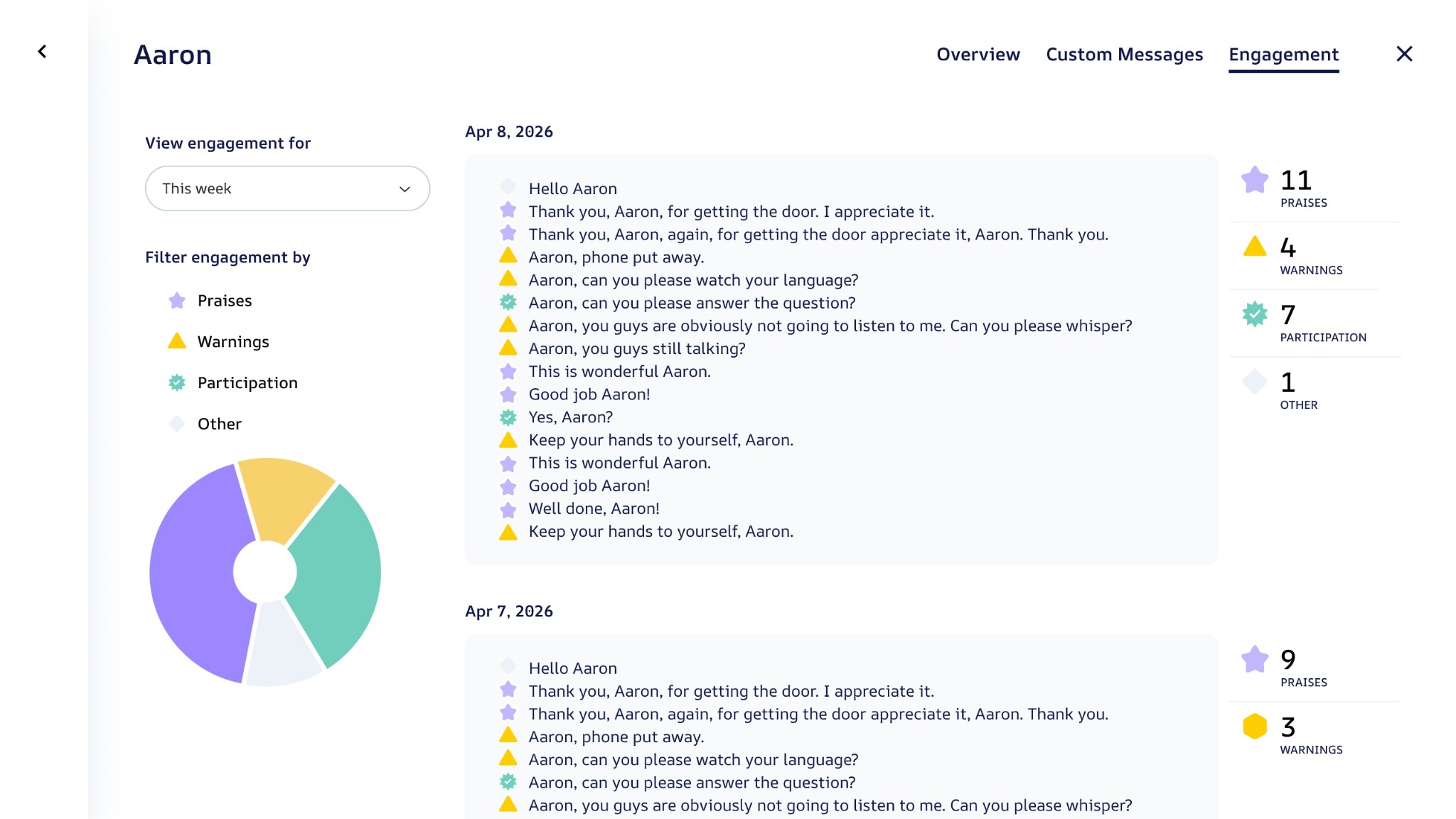
Behavior over time, the way a BIP team needs to see it
Socrait collects engagement, praise, and warnings by name and lays them out as a history you can follow across days, weeks, or the full year — the trajectory a BIP review depends on, with the positive side kept in view alongside the difficult. Because both are collected as they happen, the behavioral history stays balanced and non-punitive: it can show a replacement behavior taking hold over a marking period, not just the incidents.
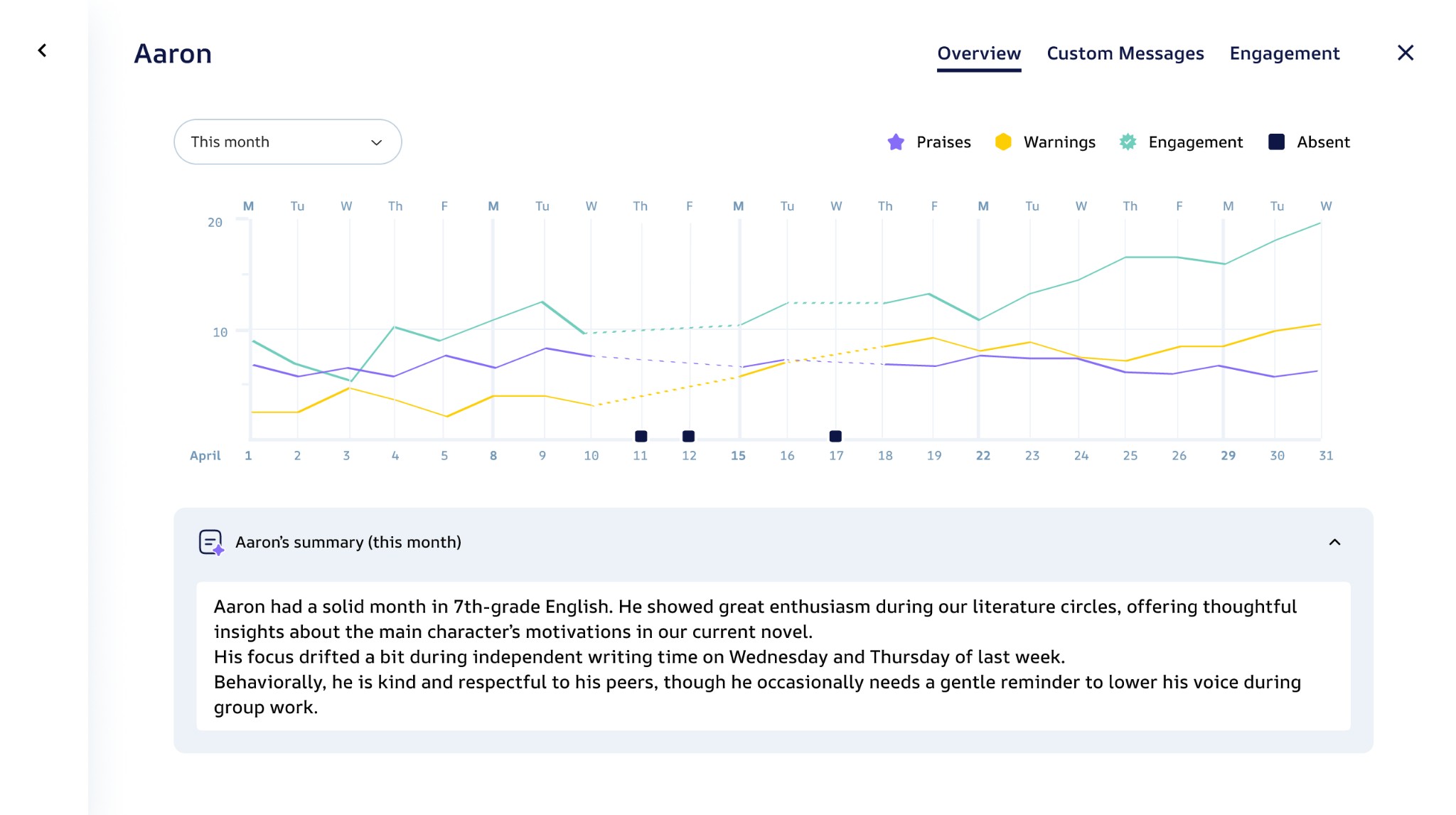
Engagement and participation, documented as they happen
Who’s participating, who’s gone quiet, how that shifts week to week, Socrait surfaces these patterns continuously, so progress (or its absence) on engagement- and participation-related goals shows up in the evidence instead of staying trapped in someone’s recollection at reporting time.
Attendance history, noted in the flow
When attendance comes up naturally in class, like who’s absent or who arrived late, Socrait notes it as part of the student’s daily history. It doesn’t replace your attendance system; it just means the context is there alongside everything else, without anyone having to remember it.
Safeguards for teachers and students
Socrait never stores audio. Transcripts are temporary and then deleted; student names are anonymized before processing; and no student or teacher data is ever sold. Socrait is FERPA-compliant and operates as a Public Benefit Corporation. The profile is built from the teacher’s own spoken observations. Socrait does not diagnose, does not infer a student’s disability or identity, and does not generate judgments about students. It is built for the teacher and the team that serves the student, not to watch the teacher or the child: it is not a surveillance tool and not an evaluation tool.
Socrait supports the IEP and BIP team with timely classroom evidence; it is not the district’s official IEP system, and it does not on its own satisfy the goal-specific measurement a plan may legally require. Confirm fit with your district’s documentation requirements.
WHAT TEACHERS SAY
The Documentation, In Their Words
Evidence you didn’t have to reconstruct
“Socrait would remind me of things that happened during class that I didn’t remember. I was able to review praises, warnings, and follow-up to share with students and parents.”
Megan Theorine
Middle School Teacher
Data that holds up in the room
“Having that bias-free data from Socrait to share with admin and parents — just the facts, just the tallies — takes away any chance for someone to say, ‘That’s just your feelings.’”
Jessie Rezba
Middle School Teacher and Union Leader
Supporting busy teachers
“Socrait is a valuable classroom companion—one that encourages fairer, more rewarding interactions with students and adds a layer of helpful documentation for a busy teacher.”
High School Teacher
Bring the Classroom Evidence From Recollection to Reality
Socrait won’t write the plan. It will make sure the classroom evidence behind it is accurate, dated, and ready because it’s collected by voice, day after day, without adding a task to the teacher’s load. See what that looks like for your IEP and BIP teams.
CITATIONS
1.
U.S. Department of Education. Individuals with Disabilities Education Act (IDEA), 34 CFR §§300.320 and 300.324. https://sites.ed.gov/idea/
2.
Floress, M. T., Jenkins, L. N., Reinke, W. M., & McKown, L. (2018). General education teachers’ natural rates of praise. Behavioral Disorders, 43, 411–422.
3.
Billingsley, B., & Bettini, E. (2019). Special education teacher attrition and retention: A review of the literature. Review of Educational Research, 89(5), 697–744. https://doi.org/10.3102/0034654319862495
4.
EdResearch for Action. (2024). Addressing Special Education Staffing Shortages: Strategies for Schools. https://edresearchforaction.org/research-briefs/addressing-special-education-staffing-shortages-strategies-for-schools
5.
Ronfeldt, M., Loeb, S., & Wyckoff, J. (2013). How teacher turnover harms student achievement. American Educational Research Journal, 50(1), 4–36. https://doi.org/10.3102/0002831212463813