The Rise in AI Schoolslop
Soundbytes is a weekly newsletter that explores the reality of teaching in an AI world.
Subscribe to receive it in your inbox each week.
Students are using AI for everything, and it’s not their fault. Every Google search now results in a tidy AI summary at the top. And with the omnipresent answers, few kids take the time to visit any of the recommended websites. Everything from a simple crossword to a written paper can now be completed by an AI tool.
Last year, I taught Entrepreneurship students how to use AI to get help drafting the trickier parts of a business plan. But teaching students to use AI ended up undermining their actual learning. Nearly every part of their 15-page plans had been heavily touched by AI, and I could no longer distinguish between student and LLM thinking. If I can’t assess whether the student learned the process of creating a business plan, was the assignment successful?
Harvard Business School recently published an article about “workslop” (AI-Generated “Workslop” Is Destroying Productivity) – the gist was that managers are getting sick of addressing the boring and often incorrect AI slop generated by some of their coworkers. When the manager has to interpret, correct, or redo the work, it “transfers the effort from creator to receiver.” Teachers are experiencing the same phenomenon, but in our case it’s “schoolslop” … submitted student work that takes the teacher longer to assess than it took the student to create.
As teachers, part of our job is to evaluate student learning on their path to mastery of a topic. AI allows students to skip the effort of learning and submit quality work with little or no mastery. Teachers are drowning in the downstream effects of this schoolslop. In the short term, grading is more difficult to navigate. In the long term, redesigning assessments is necessary.
Evaluating student learning is now difficult because teachers are acting as human AI detectives. When the teacher suspects that a student submission was likely done all or in part by AI, they can react as a:
Mentor :
Confront the student and ask them to resubmit
Disciplinarian :
Report academic dishonesty
Reflective Practitioner :
Teach the student a lesson about AI use by critiquing the work (in other words, grade the work done by AI to prove it’s not that good or has flaws)
All of these approaches take teachers more time than grading authentic student work. Schoolslop is what made my AI-contaminated business plans so exhausting to grade. AI produced well-written plans, and the strategies to build new companies were reasonably valid. Since this was not my first time teaching business plans, I knew that what I was seeing was not normal for students at this level. And when questioned, the students often could not explain the reasoning in their plans. If I could change the assignment, students would participate in an out-loud real-time discussion about their business for 15-20 minutes complete with a detailed Q&A section, but the state standards for this course don’t allow this kind of change.
Until there are new techniques to keep students’ learning on track in this shiny new AI world, teachers need valid measurements of learning. Whole assignment categories have now disappeared as options for accurately measuring learning (basically any assignment that involves writing outside of supervision). Every digital assignment can be copied and pasted into an AI tool and completed for the student. And now, even analog/paper assignments are just photographed and uploaded to AI tools for completion. The best pedagogical advice for digital assignments – make a really good rubric — now just teaches AI exactly how to produce a perfect assignment.
AI Education “experts” suggest that we combat schoolslop by making new assignments where we grade the AI prompts and process rather than the content of assignments – but that would mean we shift from measuring the learning of a subject area to measuring the learning of AI prompting. This doesn’t really align with the state standards and testing obligations that govern K-12. And if we altered every “broken” assessment to turn it into a prompting assignment, we would no longer be teaching anything but AI prompting.
The bitter irony for teachers is that the curricular overhaul brought on by COVID five years ago is now failing miserably. The assignments we created for remote learning are easily tackled by AI. And so here we are facing a complete curricular overhaul again.
Teachers are already dealing with post-COVID learning deficiencies, the rise of behavior issues in classrooms, and chronic absenteeism. Our PD days march on, packed with safety training, new data projects, and new school initiatives. Meanwhile, a large proportion of our assessment practices are failing and teachers struggle to know what students have actually learned, and many students are no longer learning.
Teachers need time to work through the creation of new learning experiences and assessments, but few of us have been given contract time to do this redesign. I’ve been working on the redesign of one course to incorporate AI in some activities and to redesign assessment so that the thinking falls to the student instead of the AI. Almost everything in the course has to change – my best estimate is that it is about 80 hours of work.
Those O.G. handwritten assignments, in-class quizzes, and active learning strategies on whiteboards might work better than ever. If you need someone to tell you it’s okay to fall back on some tried-and-true assessment methods right now, until you have the time and tools to redesign, I’m happy to oblige.
Redesign is necessary because avoiding AI would leave students at a disadvantage. We do need to think about new ways to use AI as part of the learning process. If we don’t actively teach students how to keep developing their brains alongside AI, we’ll do them a disservice. We need to be innovators that find the right moments to incorporate appropriate AI use and hold the line on those times when student brains still need to be developed. Teachers need paid days (or weeks, or whole summers) to do the redesign necessary for these new realities.
No Student Left Unorganized
One of the schools we’re working with at Socrait has built something simple and powerful into their daily study hall: “No student left unorganized.”
This isn’t just a study hall. It’s a daily block intentionally designed to support and teach students executive functioning skills like planning ahead, organizing materials, prioritizing tasks, managing time, and starting work. Instead of assuming students already know how to juggle multiple classes, deadlines, and digital platforms, the school treats these skills as essential and teachable.
That shift matters. When executive functioning is supported during the school day, students feel less overwhelmed, teachers see fewer missing assignments, and learning becomes more accessible. Organization stops being a hidden prerequisite and becomes part of the learning infrastructure itself.
Sometimes the most impactful changes aren’t flashy new programs, but small, thoughtful structures that help students succeed every day.
Inbox Serotonin
So many clever videos this week about teachers wishing for a snow day. This one wins my prize for “best use of a Friends clip” from katrina.crittenden.
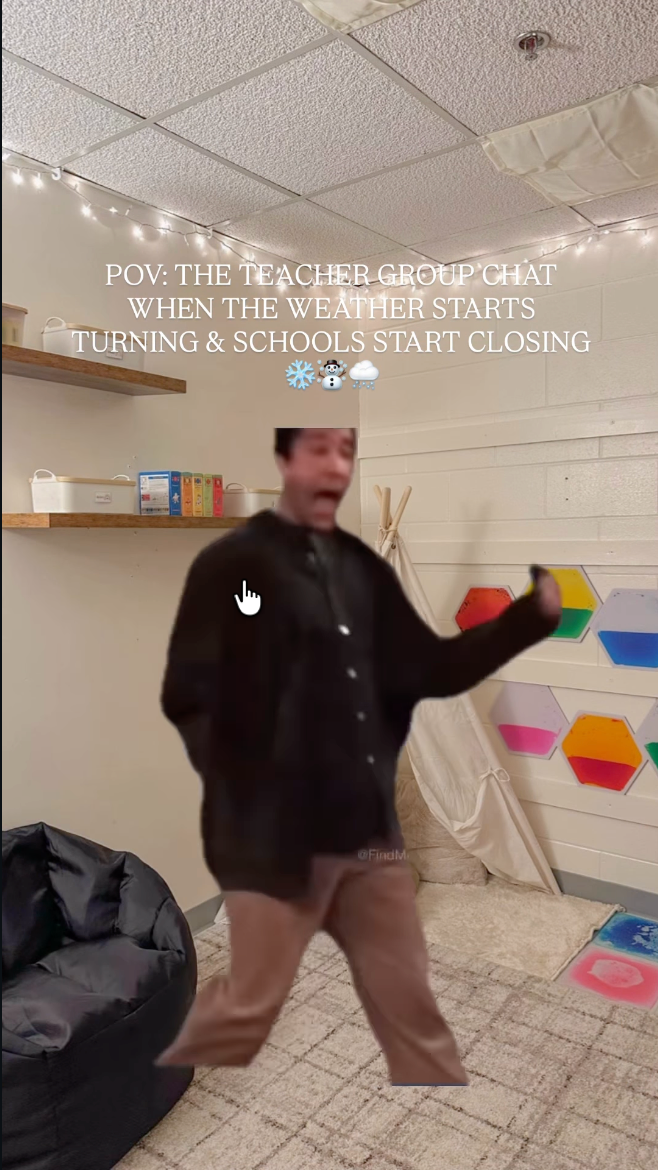
Unfortunately, here in Utah, in an unusually dry winter, we are not going to have a snow day. This post has clever use of song by tarync89 on Instagram to represent those of us.
Favorite Things: Reminders
I don’t know about you, but some days I have such a long to-do list at the end of the day. Before Socrait, I knew I had things to do, but couldn’t remember them. That always resulted in a bad next day. You know, when you are 5 minutes into class and suddenly remember those things you meant to do but forgot.
Thanks to Socrait, now the to-do list is waiting for me at the end of the day so I can power through it. Here was my Reminders list from one teaching day:
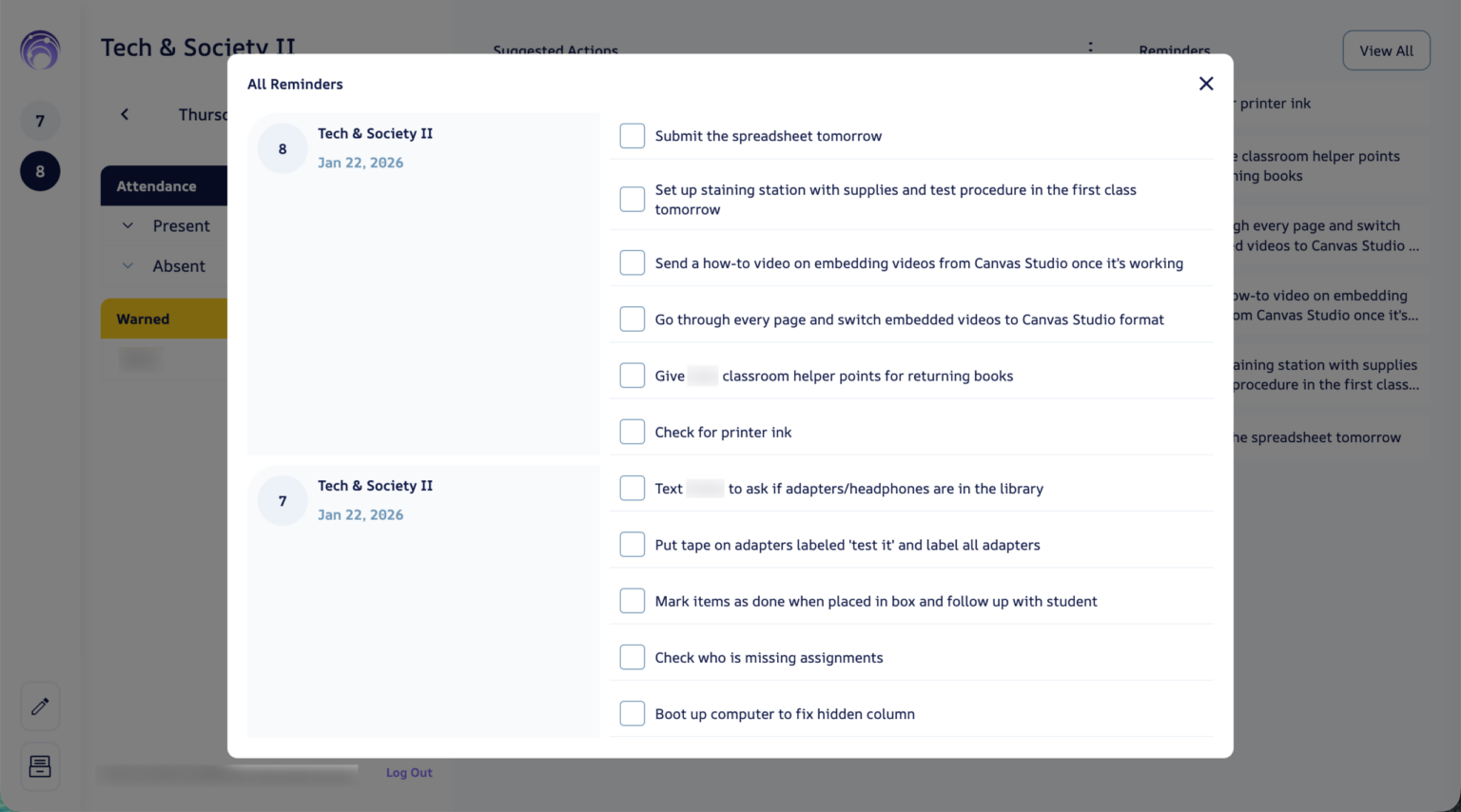
What always strikes me about these Reminder lists in Socrait is how many unrelated to-dos Socrait grabs from my teaching! If you want to see just how many hats a teacher wears, look at their to-do list.
Just from this one list you can see I am acting as an online instructional designer, tech support for students, tech support for classrooms, experiment designer, club advisor, absence coach, and cheerleaders.
Reminders are rapidly becoming one of my favorite things.