
The Students I Was Forgetting
Soundbytes is a weekly newsletter that explores the reality of teaching in an AI world.
Subscribe to receive it in your inbox each week.
There’s a quiet group of students in every classroom who don’t get enough attention. They’re the kids who come in, sit down, get to work, stay quiet when asked, and do exactly what’s asked of them. They don’t demand attention. They don’t escalate. They don’t create moments that force me to stop teaching and intervene. And because of that, they’re dangerously easy to overlook.
Classroom behavior has gotten harder in the last few years, and teachers know it. Survey after survey tells the same story: more disruptions, more emotional dysregulation, more time spent managing behavior instead of teaching. Even on good days, a handful of moments pull all of the oxygen out of the room. A student refuses to comply. Someone melts down. A conflict flares. By the end of class, those moments are what stick in my memory. Not because I want them to, but because our brains are wired to remember what went wrong.
Psychologists describe a “negativity bias,” the well-documented tendency for negative experiences, information, and behavior to be more attention-grabbing, richly encoded, and persist longer in memory than positive ones. Classic research shows that negative events have a stronger psychological impact than positive events of equivalent strength — a phenomenon articulated in Baumeister et al.’s influential 2001 review “Bad Is Stronger Than Good.” Subsequent work has confirmed that negative information dominates cognitive processing across age groups and tasks, shaping attention, learning, emotion, and recall.
That bias doesn’t just affect what we remember at the end of the day. It quietly shapes how we respond in the moment. When classrooms get noisy and attention is scarce, the students who demand intervention naturally pull us toward action. And research suggests that this isn’t random. In a 2011 study published in the Journal of Educational Psychology, teachers were asked how they would respond to hypothetical students who were shy and quiet versus students who were talkative and exuberant. Teachers consistently said they would intervene directly with the talkative students: offering explicit feedback, behavior strategies, and active support. With the quiet students, they were far more likely to take a passive, wait-and-see approach.
What’s harder to sit with is what lies underneath those choices. In the same study, teachers were more likely to assume that shy or quiet students were less intelligent and predicted lower academic success for them, even when the only difference described was how much the student spoke. The students who disrupted class triggered action. The students who stayed quiet triggered assumptions. And over time, those assumptions matter. The researchers warn that this pattern can quietly turn into a self-fulfilling cycle, where students who don’t demand attention receive less encouragement and fewer opportunities, not because they don’t need support, but because they don’t signal it loudly.
And that’s the part that gives me real angst. When I slow down and think about it, I know I am not praising the on-task, well-behaved students nearly as much as they deserve. Not because I don’t value them. But because the day is noisy, cognitively overwhelming, and full of small fires that demand immediate attention. By the time class ends, what I can recall clearly are the warnings, the redirections, the things that needed fixing. The quiet successes fade fast.
I’ve felt this gap for years. Sometimes on the weekends, I think about those students that I am forgetting to pay more attention to. But the truth is, that when you think about it, you can’t remember the data. And remembering to balance praise with correction in real time is incredibly hard. Teachers are making hundreds of micro-decisions per class period, and our working memory fills up quickly. The longer the day goes on, the more our recollection skews toward the problems instead of the progress.
Great Behavior Insights
Once Socrait started collecting voice-based classroom data, I realized that we had a solution to the “forgotten students” problem. We know all the kids that were warned about behavior in class, which means we also know the kids who weren’t warned! And now, we’re giving that data back to teachers.
At the end of every week, we will surface “weekly insights” and the first insight is called “Great Behavior.” It’s about helping us notice and remember the students who are quietly doing the right thing. The ones who stay focused. The ones who follow directions. The ones who help make the classroom work. Not only will the data be there, but also the reminder to do something for these students: acknowledge them, reinforce them, and make sure those students know they are seen.
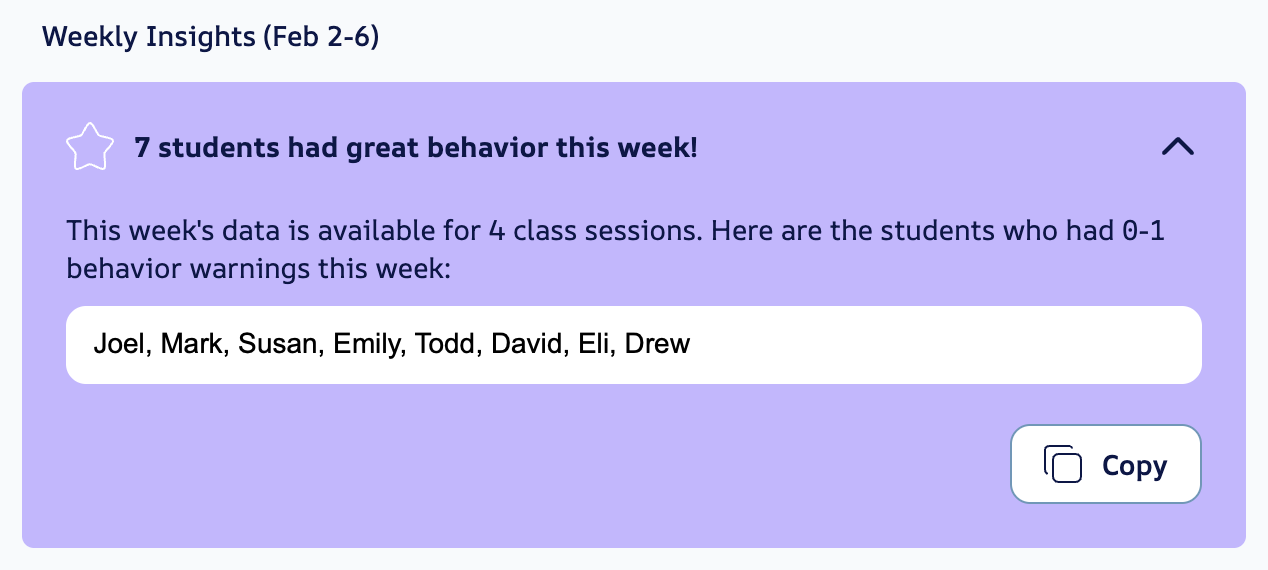
Not only do we find the well-behaved students for you, but we also add a to-do item so you don’t forget to do something!
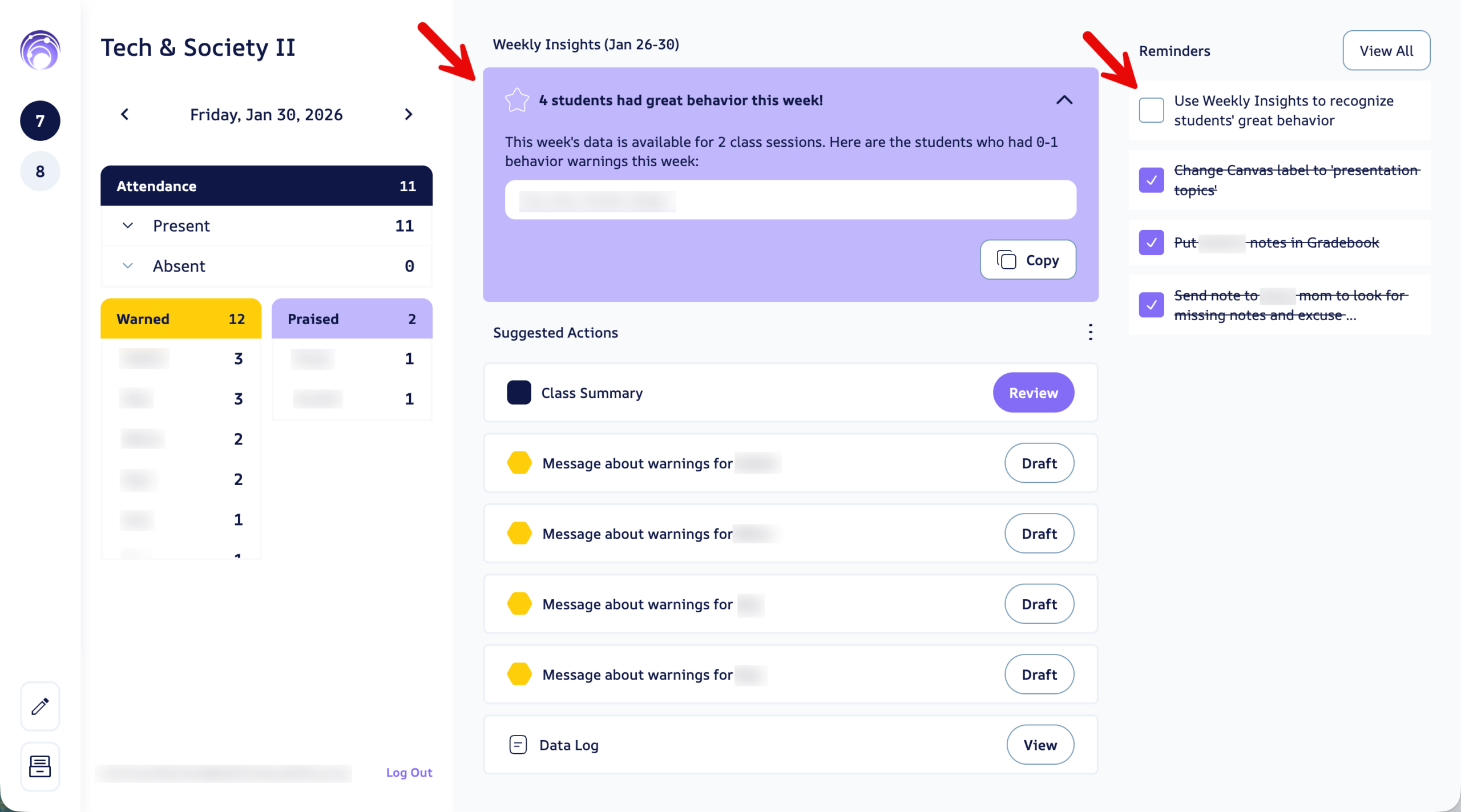
Classroom culture isn’t built only by managing only the hard moments. It’s built by consistently recognizing the steady ones. And without help, those are the moments teachers are most likely to forget.
Drawing for Classroom Supplies!
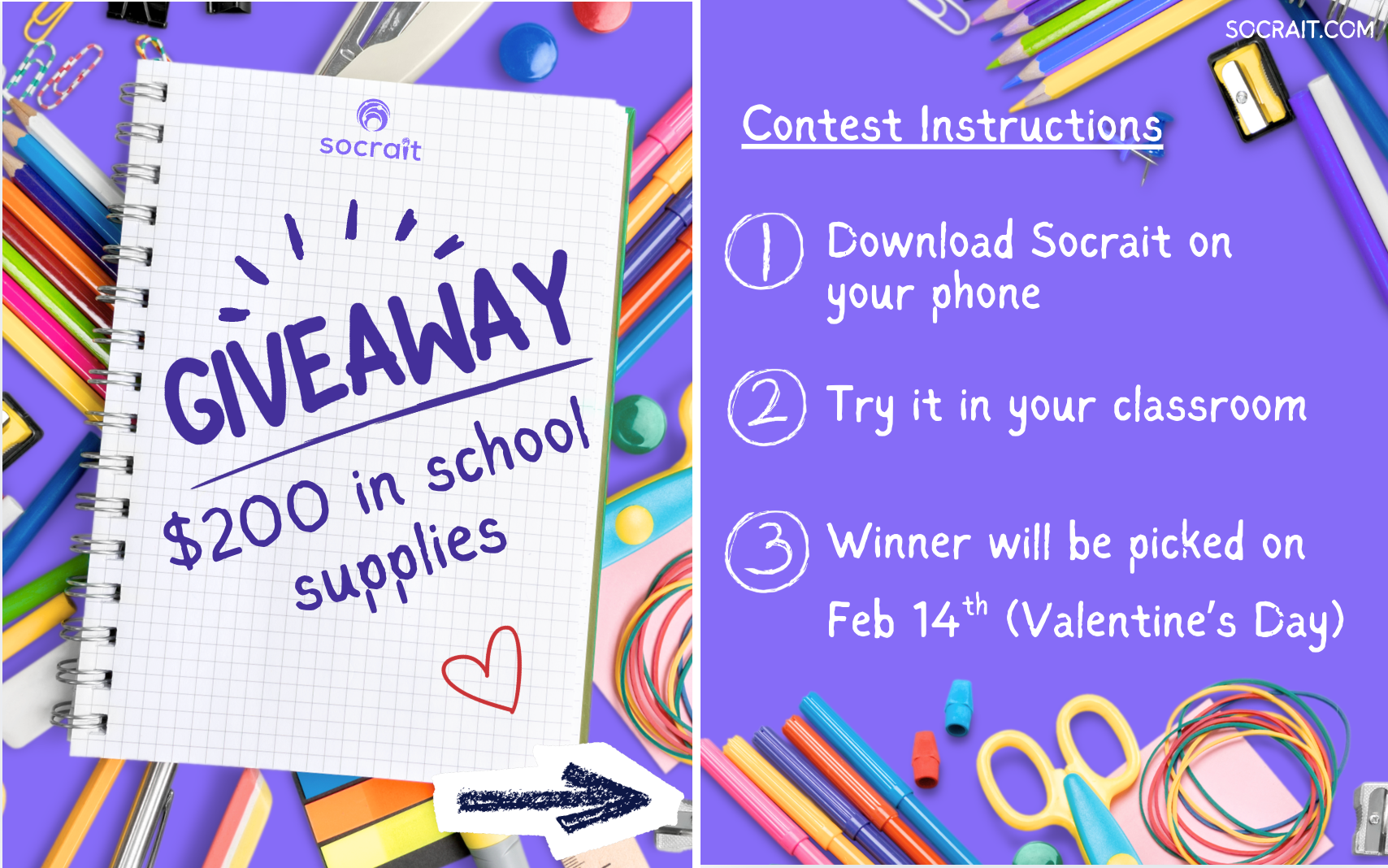
If you haven’t given Socrait a try, and you’d like to, here’s a little extra nudge this week. On Valentine’s Day, we’ll draw a name from new Socrait users to get classroom supplies! All you have to do is signup to try Socrait and actually use it in your classroom.
Inbox Serotonin
This might be a fun thing to do with your elementary class if you have access to AI video creation: Children’s drawings brought to life by AI from Glizmaa on Instagram.

When you ask the students to keep the caps on their markers from vibegrade on Instagram.

And finally, for those of you who teach high school, a little parent insight about the behavior of human teenagers in the wintertime from parentingtweensandteens on Instagram.